github.com/Zhanyl-tech/slurm-scheduler-lab · MIT · Python 3.10+
Changing PriorityWeightFairshare on a production cluster is a slow, expensive
experiment: the feedback loop is days long, the blast radius is everyone’s
queue, and the only rollback signal is people complaining. This runs the same
policy against a workload in about a second.
What it models
Multifactor priority — the real formula from priority/multifactor, with
age, fairshare, job size, partition, and QOS factors each normalised to [0,1]
so the weights alone decide what the queue optimises for. Fairshare uses
Slurm’s classic F = 2^(-U/S) with exponential usage decay.
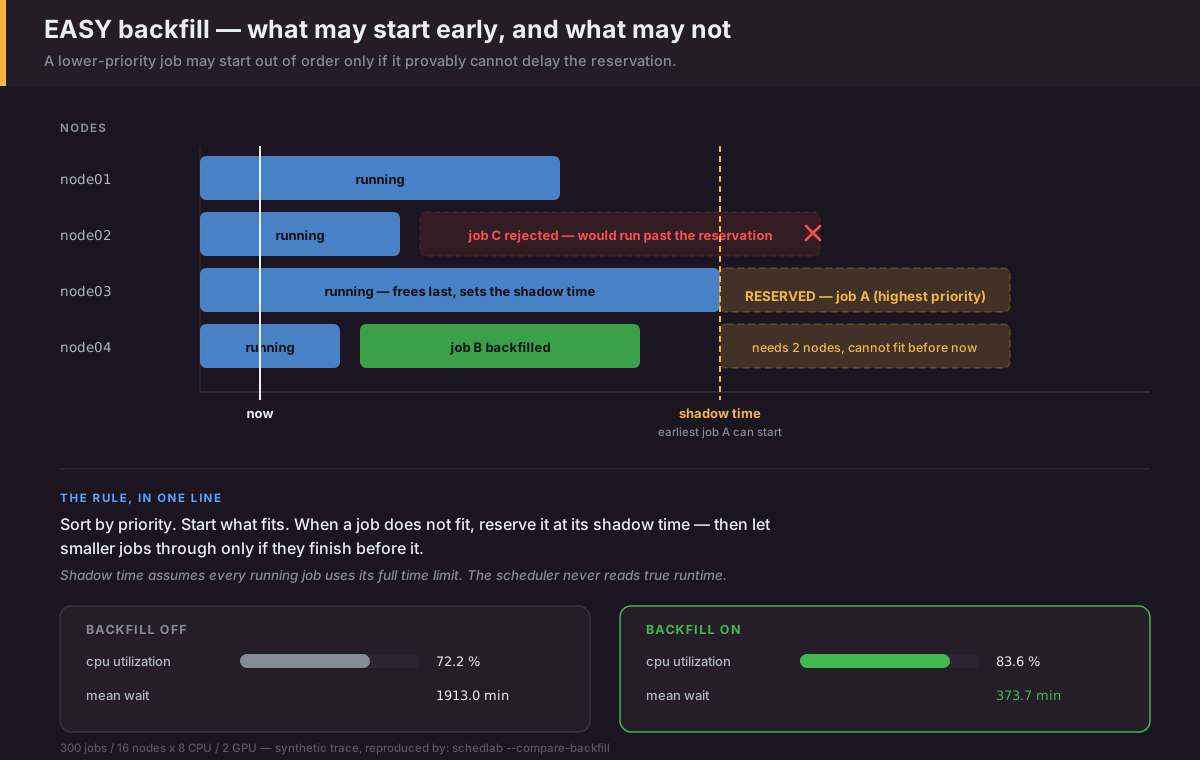
EASY backfill — priority-ordered dispatch with shadow-time reservations. The
scheduler is never allowed to read a job’s true runtime, only its requested
time_limit, which is what makes over-requesting visible as a measurable cost.
Using it on a real cluster
sacct -a -X --parsable2 --starttime=now-30days \
      --format=JobID,Account,Submit,Elapsed,Timelimit,NNodes,ReqCPUS,ReqTRES \
      > trace.txt

schedlab --sacct trace.txt --slurm-conf /etc/slurm/slurm.conf --nodes 64
It reads PriorityWeight* straight out of the config you are about to deploy,
so you can compare the config you have against the config you are considering.
What it found
| backfill off | backfill on | |
|---|---|---|
| CPU utilization | 72.2 % | 83.6 % |
| Mean wait | 1913.0 min | 373.7 min |
| Median wait | 2303.3 min | 131.9 min |
| Bounded slowdown | 373.18 | 55.66 |
Sweeping PriorityWeightJobsize across 100,000x moves mean wait about 40%.
Backfill moves it 400%. The number that actually explains the queue turned out
to be time-limit accuracy — jobs using ~32% of the wall-clock they request.
Written up in Your Slurm priority weights matter less than your users’ time limits.
Scope
Deliberately not a Slurm reimplementation: first-fit node selection with no topology awareness, aggregate rather than per-node backfill reservations, flat fairshare, no preemption or gang scheduling. Good for comparing policies against each other on the same workload; not for predicting absolute wait times.
23 tests cover reservation safety, fairshare maths, capacity invariants, and determinism across identical seeds.