github.com/Zhanyl-tech/gpu-reaper · Go · MIT
make demo
No cluster, no GPUs, no risk — fake squeue, simulated telemetry, observe mode.
Two jobs get classified as hung and escalate from alert to drain in about
thirty seconds.
The problem
A researcher requests 16 H100s for 48 hours. Four hours in, the training script
deadlocks on an all-reduce because one rank died. The allocation is still held.
Slurm is content: the job is RUNNING, the nodes are busy, the queue is moving.
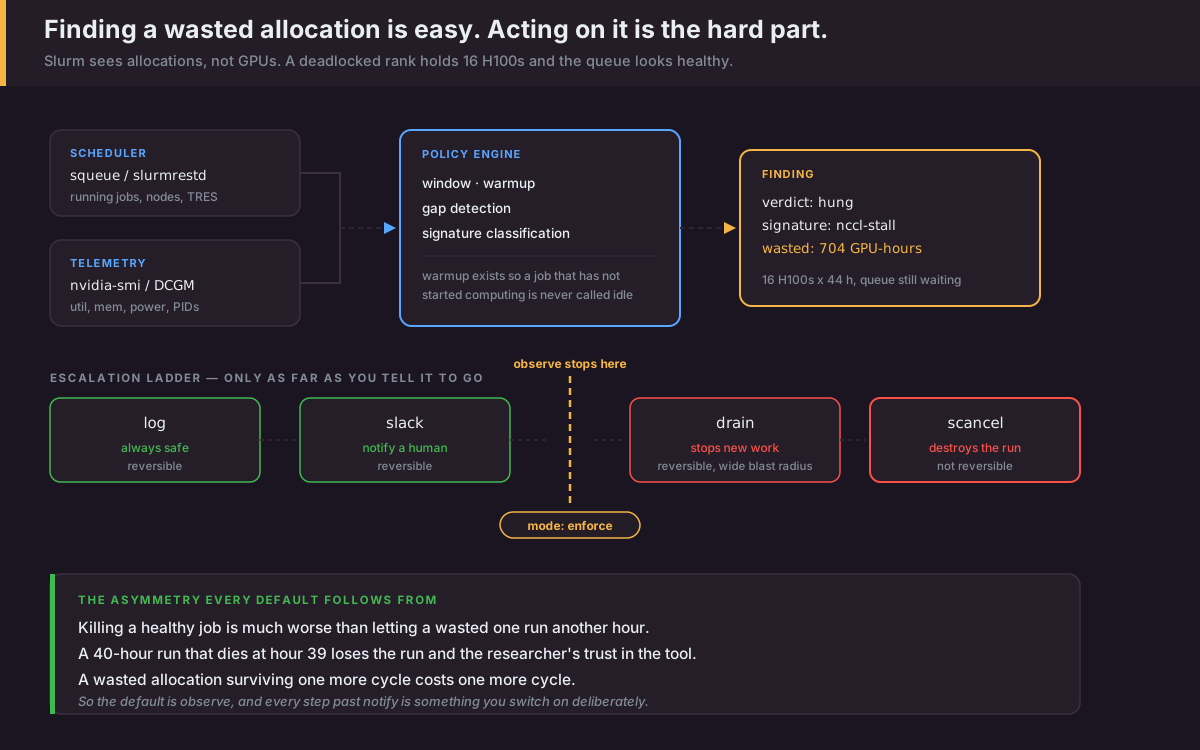
Slurm does not look at GPUs. It looks at allocations. That gap is 16 GPUs × 44 hours — 704 GPU-hours of a contended resource, consumed by a process doing nothing.
Why it will not kill your job
The whole design follows from an asymmetry: killing a healthy job is far worse than letting a wasted one run another hour. A researcher whose 40-hour run dies at hour 39 loses the run and their trust in the tool.
So: observe mode is the default, enforcement is opt-in, and escalation requires sustained evidence. Concretely —
- Jobs younger than the warmup are never judged. Container pulls and dataset staging legitimately show zero utilization.
- A breach must hold across the entire window. One busy sample clears the finding, because evaluation is on peak, not mean.
- A hole in the samples is treated as a collector fault, not idleness. This is the guard that stops a monitoring outage from cancelling the whole cluster.
- Cancel requires a previous cycle to have alerted and drained. No config change can jump a job straight to termination.
Signatures
Low utilization has several causes, and they deserve different responses.
| Signature | Evidence | Meaning | Ceiling |
|---|---|---|---|
idle | No memory, no processes, idle power | Allocation is empty | cancel |
hung | Memory held, processes resident, zero compute | Deadlocked collective | cancel |
starved | Memory held, low but nonzero compute | Dataloader bottleneck | alert |
unknown | Breaching, no match | Not modelled | alert |
Starvation caps at alert deliberately. A slow dataloader is a tuning problem,
and cancelling someone’s run over one is how a tool gets uninstalled.
What building it taught me
Two bugs worth recording, both found by CI rather than by me:
.gitignore matches at any depth. A bare bin/ silently excluded
demo/bin/, so the fake squeue the demo depends on never left my laptop. The
demo the README promised could not have worked for anyone who cloned it. The
fix is anchoring — /bin/.
$(PWD) is not guaranteed in make. It comes from the environment; on the
CI runner it expanded to empty and the demo’s PATH prepend silently did
nothing. $(CURDIR) is make-native and always set.
Neither is exotic. Both were invisible locally and obvious the moment something other than my machine ran the code — which is the argument for having the demo itself be a CI job.
Limitations
GPU samples identify a node, not a job. Where a node hosts several GPU jobs, attribution is ambiguous and the reaper skips them rather than guess — a false alert on a healthy job costs more than a missed finding costs GPU-hours. Correct attribution needs the Slurm cgroup hierarchy to map GPU PIDs back to job IDs, which is the subject of the next tool.
It reads nvidia-smi rather than DCGM, so utilization is coarse: a kernel
occupying one SM reports the same 100% as a saturated device. That is exactly
why high utilization is never treated as proof of health — only low utilization
as evidence of a problem.